
SY Department
Accelerator Systems Department
Health and Safety
Obligatory Personal Protection Equipment
Safety Information Registration
Document Management
EDMS folder of the section and group
IT General Grammar and Style Guidelines
Procurement
Quality and Planning
Accelerator Entities & Signals: Naming Portal
Departmental Space Manager assistant( works, repairs, removals)
Service requests
Software tools
INDICO
Projects and equipment
TCD projects and equipment documentation can be found via CERN’s Engineering Data Management Service (EDMS). All relevant data is accessible through the EN-STI-TCD EDMS folder CERN-0000077570. In Infor EAM, which is integrated with EDMS, is used for asset (equipment) & maintenance management.
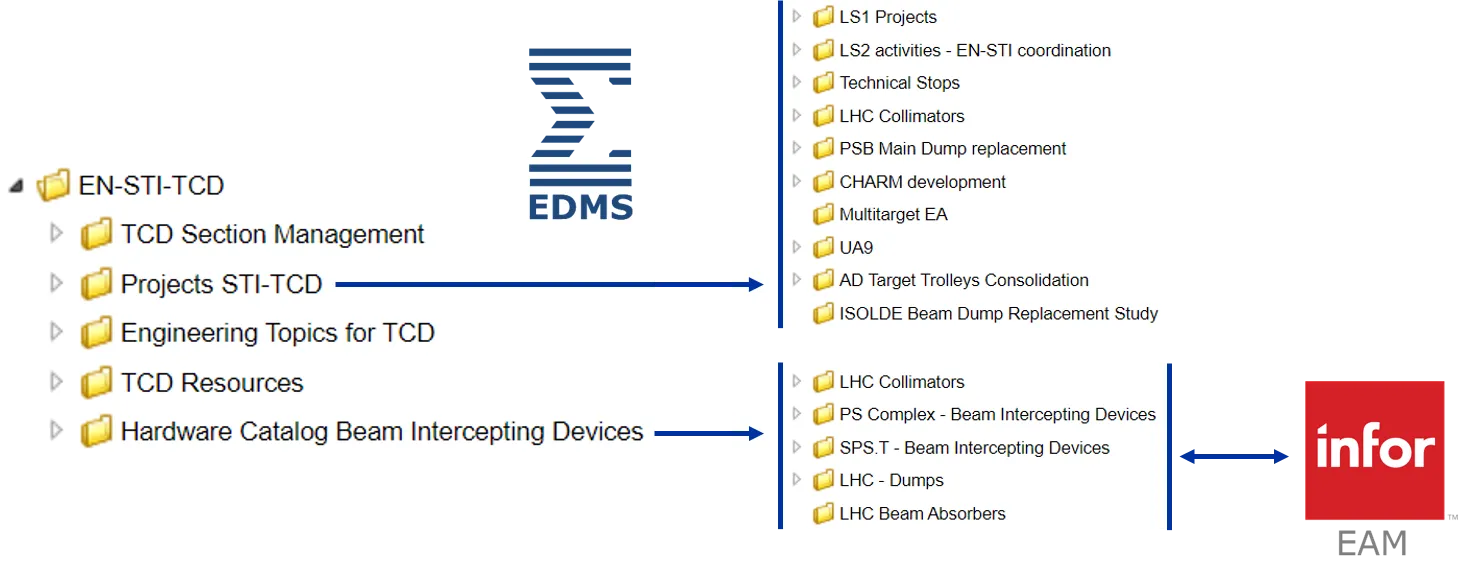
The different pieces of equipment developed by TCD are grouped into three different categories depending on its function:
Beam Intercepting Devices (BIDs)
(click to jump to description)
Safety devices | Beam cleaning and control | Experiments |
 |  |  |
Safety devices
Beam Dumps
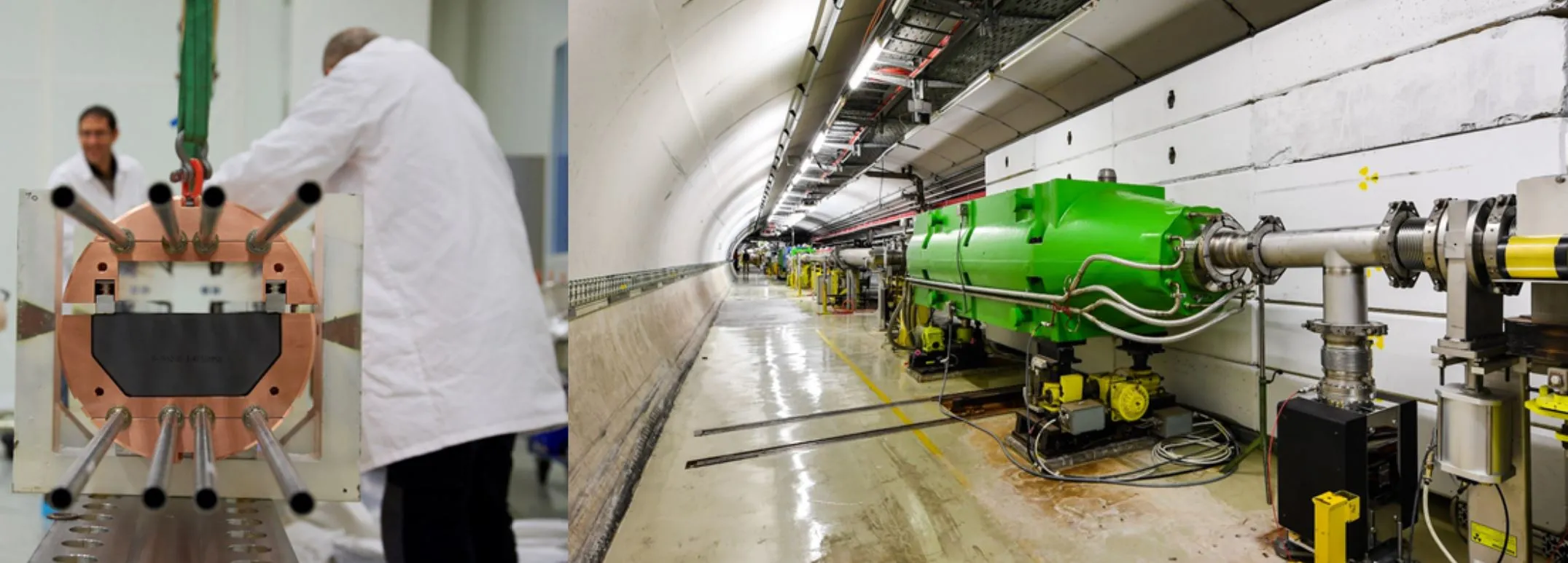
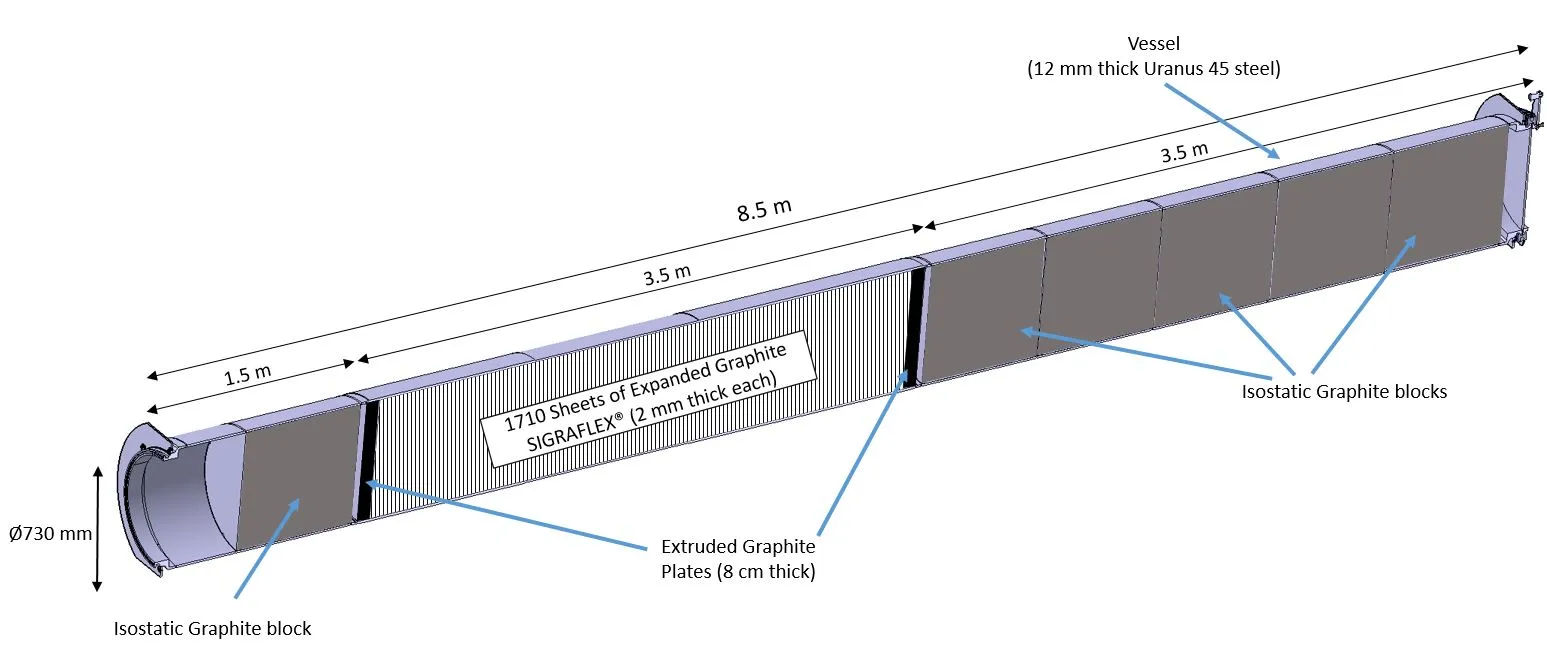
Beam dumps are devices used to dispose off the beam whenever this action is required for the operation of the accelerator complex.They are designed to continuously absorb the energy of the beam circulating in the upstream accelerator or transfer line. The energy of the beam is absorbed completely or partially, in such a way that the eventual reminiscent unabsorbed energy is minimised and the required level of machine protection is guaranteed (on a case by case basis).
Beam Stoppers
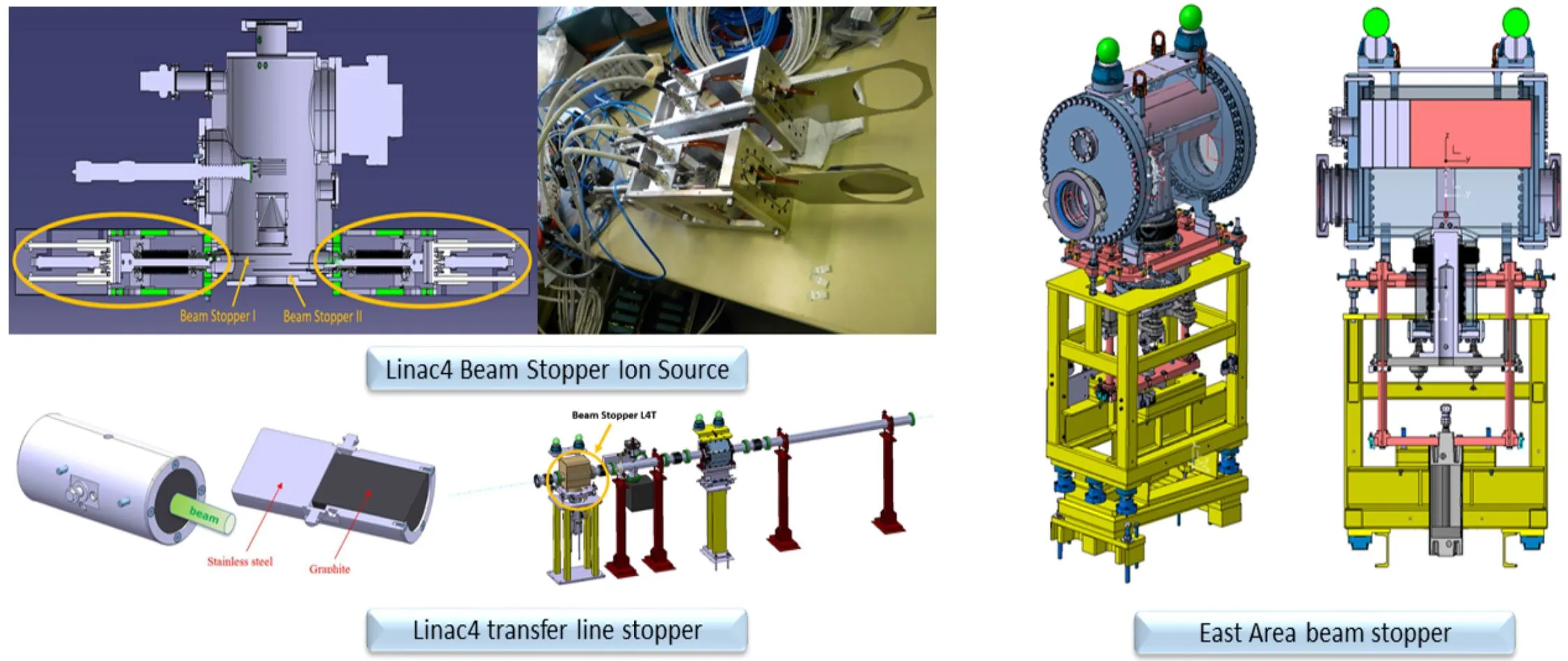
Beam stoppers are components used as part of the access safety system that ensures the safety of workers in the accelerators. They are designed to stop one or at most a few pulses of the beam in very rare accidental cases, in such a way that the remaining unabsorbed primary or secondary beam is not harmful.
The beam stopper moves into the beam line as a response command from its control system, when an operator wants to give access to the downstream facilities. Beam stopper are interlocked within the access safety system as one of the EIS (Elements Importantes pour Sureté).
Beam cleaning and control
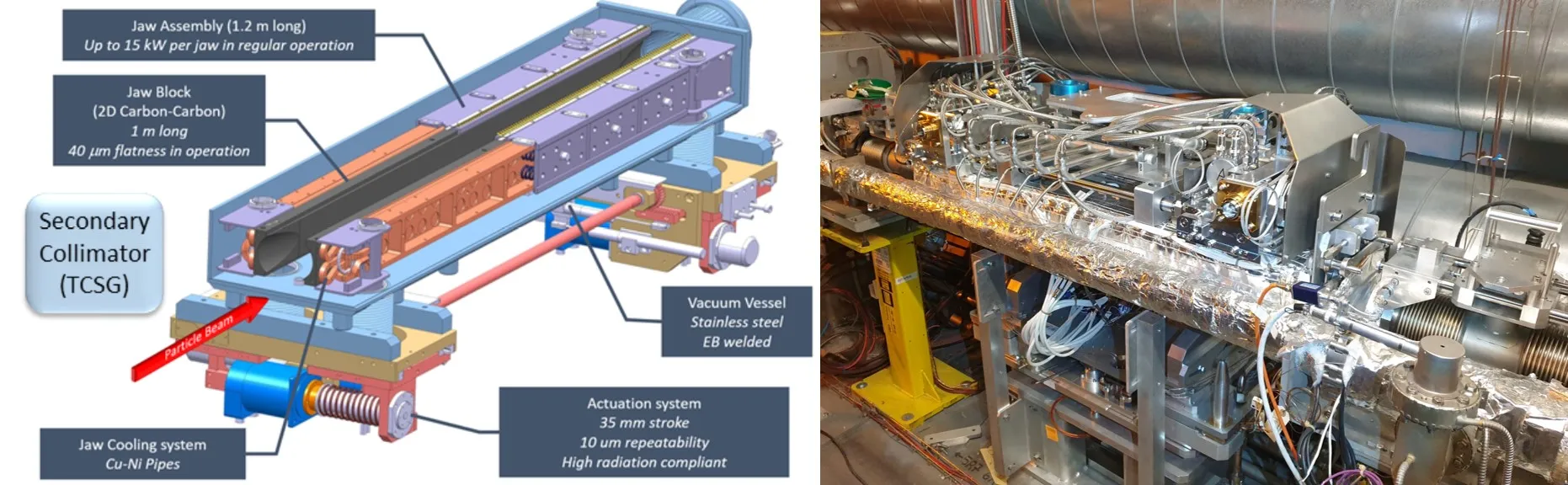
Collimators
In all types of linear and circular accelerators, collimators are required to narrow the beam of particles. Owing to differences in the construction of the various types of accelerators, there are various approaches to beam collimation. In linear accelerators (e.g. Linac), it is important to colIimate the beam before the target or before/within the transfer line. In this type of machine, the beam interacts with the collimating system only once. In contrast, in synchrotrons (e.g. PS and SPS) and accumulator rings, the collimating system affects the beam parameters continuously and the location of the collimator is more critical.
In general, collimators are used to:
- Clean the beam
- Protect the machine against beam damage
- Protect the experiments from background
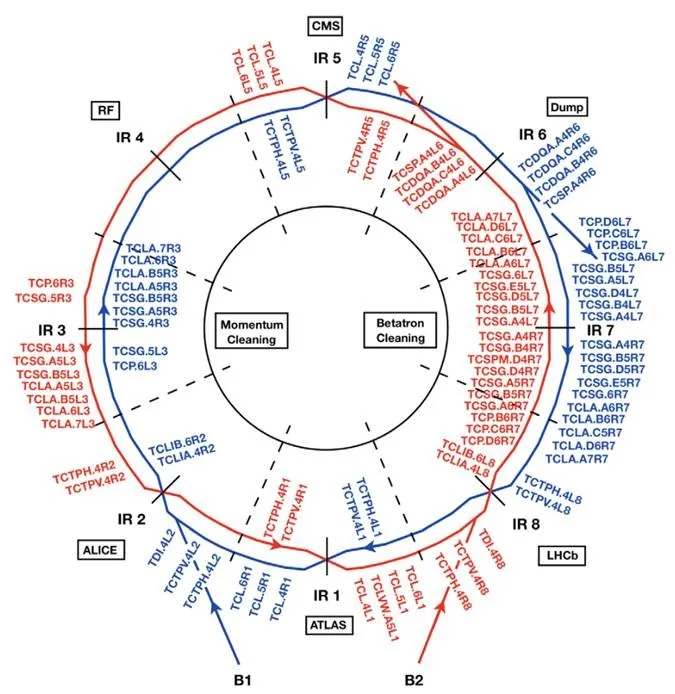 | LHC collimation systyem TCP: Beam cleaning and general protection (stage 1) TCSG: Beam cleaning and general protection (stage 2) TCT: Protect the triplets (stage 3) TCLA: Intercept the cleaning-induced shower TCLP: Catch the showers induced by experiments (p-p collisions) TCDI: Injection collimation TCLI (A&B): Active injection protection TCAPx: Passive absorbers TCTP: TCT with BPM, replaces all TCTs in P1, P2, P5 and P8 TCSP: TCSG with BPM (replaces TCSG in P6) |
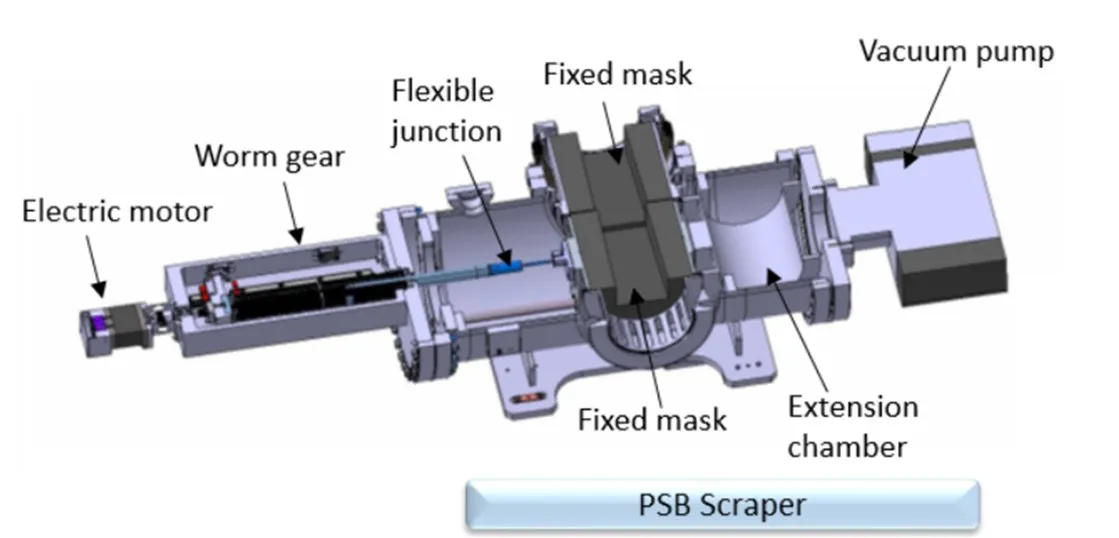
Scrapers
Beam scrapers are useful for measuring beam properties, removing beam halo and reduce beam size. Scrapers consist of two one-sided copper jaws, one for each of the transversal planes, which “scrape” by quickly sweeping through the beam.
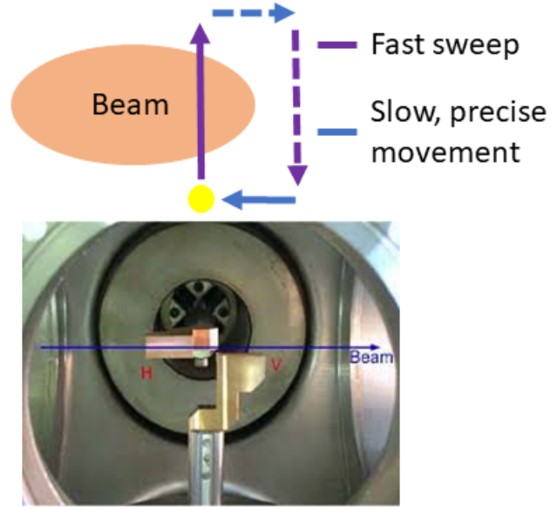
Schematic view of SPS scraper jaw movement during operation. By means of fast sweeping crossing beam trajectory (starting from parking position -yellow dot-) the tails outside requested beam side are cut off.
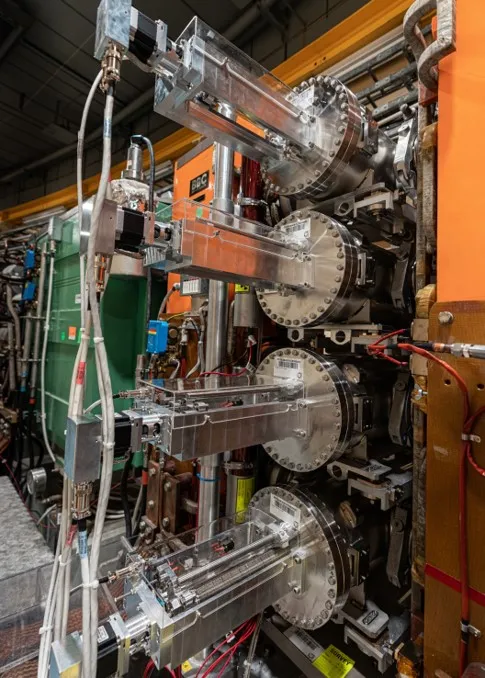
Slits
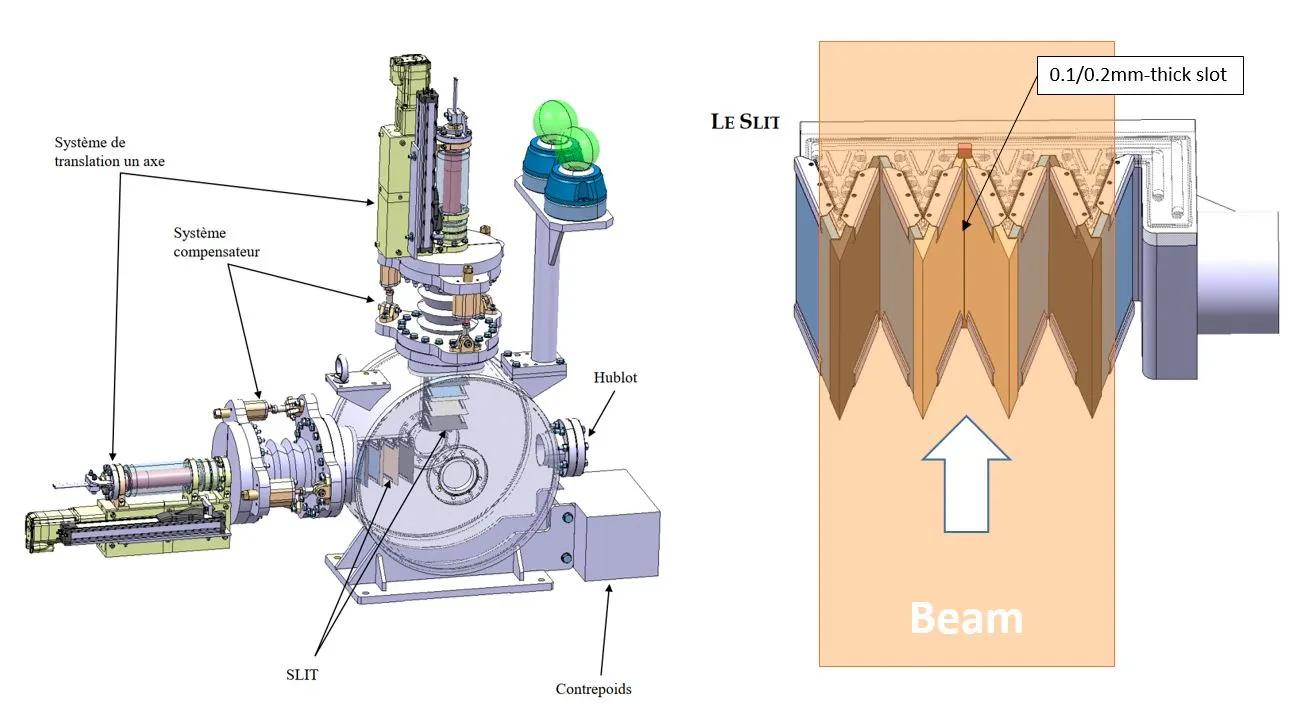
Slits coupled with a grid system are used as a typical method for measuring the transverse emittance. For each Slit position, the narrow aperture allows the passage of a beamlet populated by particles that have an almost equal position and a certain angular distribution.
In the following driftspace, the beamlet angular distribution is transformed into a position distribution and sampled using a profile monitor.
Strippers
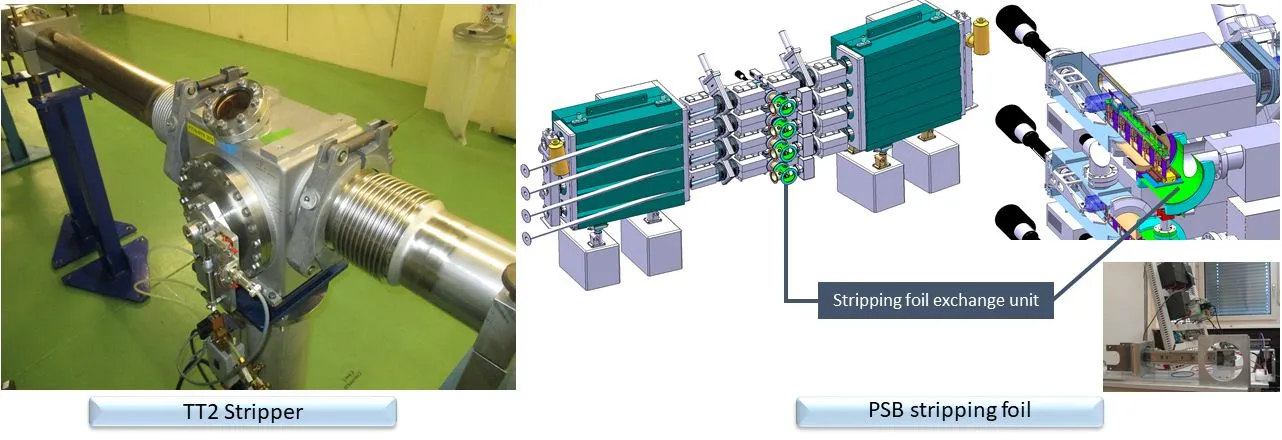
Strippers are devices developed to change the charge of particles from negative to positive by making them pass through a thin layer of matter, designed to meet the required operational parameters.
Normally, very thin foils are used in order not to modify the beam energy. Due to its fragility, the foils are prompted to be damaged by the beam, therefore multiple foil holders are integrated into the Strippers to be able to change the beam exposed foil as it degrades with use.
There are different methods used for stripping, for instance carbon, silicon or diamond coilsor laser based systems.
Experiments
Targets
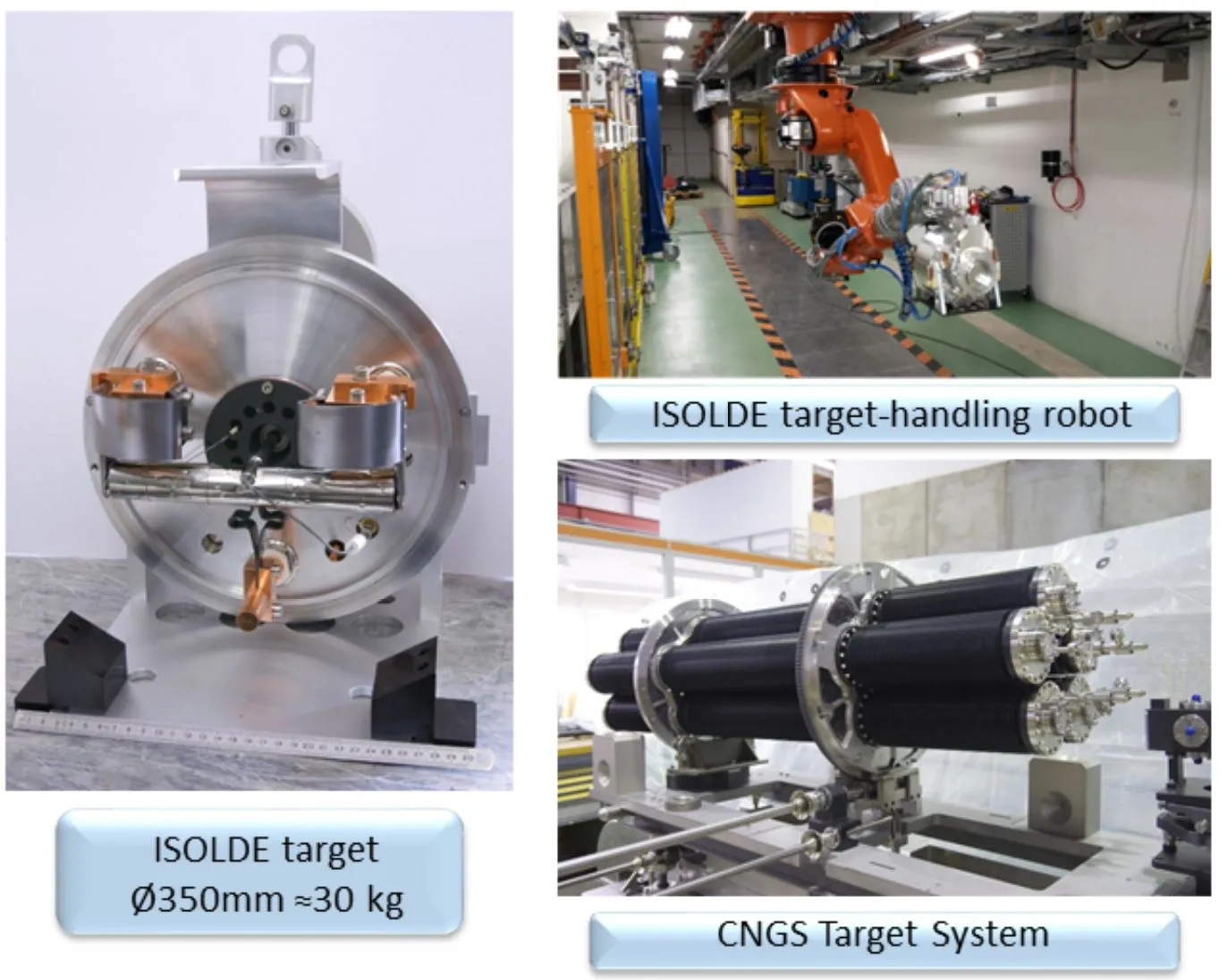
A target is an assembly of materials that intercepts accelerated particle beams to produce secondary particles. The generated particles may be the object of interest (e.g. study decay products) but can also be used as probes to investigate other objects (e.g. physical properties behaviour under irradiation), or in some cases to produce further particles on secondary targets.
In “fixed target’ experiments, a beam of accelerated particles is directed at a solid, liquid or gas target, which itself can be part of the detection system.
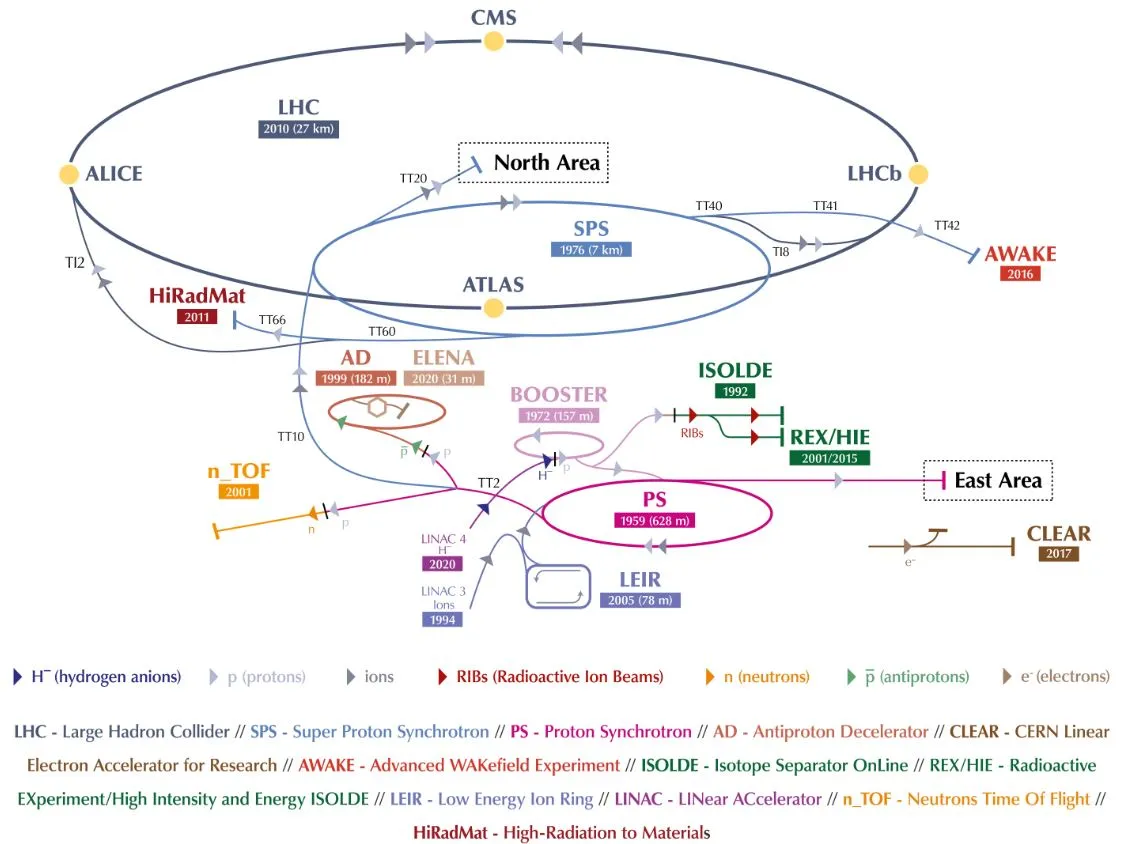 |  |
As highlighted above, some of these experiments are:
- COMPASS, which looks at the structure of hadrons (particles made of quarks), making use of the Super Proton Synchrotron (SPS) beam.
- NA61/SHINE studies the properties of hadrons in collisions of beam particles with fixed targets
- NA62 studies rare decays of kaons using protons from SPS
- DIRAC investigates the strong force between quarks at the PS
- CLOUD experiment is investigates a possible link between cosmic rays and clou formation
- ACE, AEGIS, ALPHA, ASACUSA and ATRAP all use antiprotons generated with the Antiproton Decelerator Target.
- ISOLDE, the radioactive ion beam facility
- n_TOF, neutron time-of-flight facility
Logo credits: Safety by Ricki Tri Putra; equalizer and microscope by Deemak Daksina from the Noun Project